 Many Card Games
Rummy 500 rules
Take the whole discard pile if you can use the card at the bottom of it.
- 2-8 players
- Standard deck
Rummy where scoring runs across the whole game rather than the hand — and where the discard pile is fair game all the way down.
The deck
A 52-card deck, or two decks with more than four players. Seven cards each, thirteen for two players.
The key difference
The discard pile is spread out so every card is visible. On your turn you may take the top card as usual — or take any card deeper in the pile, provided you take every card above it too, and immediately meld the card you were after.
That one rule changes everything. The pile becomes a resource, discards become dangerous, and a player who has been hoarding can pick up fifteen cards at a stroke.
Your turn
Draw from the stock, or take from the discard pile as above. Lay down melds, and lay off onto anyone's melds — including your opponents', which scores for you. Discard one card.
Melds
Sets of three or more of the same rank, and runs of three or more in suit. Aces may be high or low but not both at once.
Going out
A player who melds and discards their last card ends the hand.
Scoring
Each player scores the value of the cards they have melded, and subtracts the value of the cards still in their hand. Aces count 15, court cards 10, and number cards their face value.
A player can finish a hand with a negative score. The game runs until someone reaches 500.
Rummy 500: an example game
One game of Rummy 500 followed from the deal to the finish, move by move, with the reason for each choice.
The deal
Three players — you, Ada and Bo — seven cards each, playing to 500. The 4♦ is turned up to start the pile.
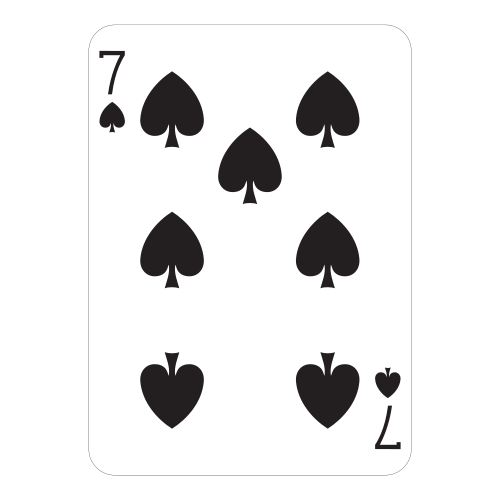
You hold 7♠ 8♠ 9♠, 4♣ 4♠, K♠ and A♥.
The first melds
You draw 2♣ from the stock, lay down 7♠ 8♠ 9♠ — 24 points on the table — and throw the 2♣. You keep 4♣, 4♠, K♠ and A♥.
Ada lays down K♣ K♦ K♥, 30 points, and throws 5♥.
Reaching into the pile
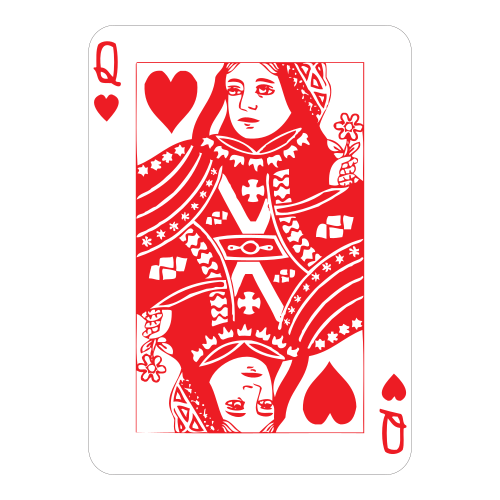
A few turns later the pile, from the bottom, reads 4♦, 2♣, 5♥, J♦, 9♥, 6♠. The 4♦ is the one you want: with 4♣ and 4♠ it is a set.
You take it, and with it everything above: six cards. You must use the 4♦ at once, so you lay down 4♣ 4♠ 4♦ for 12, and the 6♠ goes onto your own run of spades for 6 more.
Laying off on Ada
Your K♠ fits Ada's kings. You lay it on her meld, and the 10 points are yours, not hers. You throw the 2♣ back.
You are left holding 5♥, J♦ and 9♥ — passengers from the pile — and the A♥.
Ada goes out
On her next turn Ada lays down her last cards and throws her final one. The hand ends.
You have 52 points on the table: 24 for the spade run, 12 for the fours, 6 for the 6♠ and 10 for the K♠. You are caught holding 5♥, J♦, 9♥ and A♥: 39. Your hand is worth 52 − 39 = 13. Ada laid down 64 and holds nothing, so she scores 64. Bo laid down 18 and is caught with 27, so he scores −9.
What the hand shows
The deep take was worth it for the set and the 6♠, but its passengers cost 24 of the 39 you were caught with — and the A♥ alone was 15.
The game goes to 500, so there is a long way to go. Next time, you might throw the ace early and take only the cards you can lay down.
Found a mistake, or something unclear, in these rules? Tell us