 Many Card Games
Court piece rules
Cards dealt five at a time, and tricks collected in sets of four.
- 4 players
- Standard deck
Known as rang in Pakistan and northern India, and as seven hands elsewhere. Four players in partnerships, with tricks collected in bundles rather than counted one by one.
Getting ready
A 52-card deck, aces high. Thirteen cards each, dealt five at a time.
Choosing trump
The player to the dealer's right receives the first five cards and names the trump suit from them alone. The remaining eight are then dealt to everyone in batches of four.
The play
The trump-caller leads. You must follow suit if you can; if you cannot, you may play anything. Highest trump wins, otherwise the highest card of the suit led.
The bundles
This is what makes court piece its own game. Tricks are not simply counted. A partnership sets tricks aside in a pile, and only once a side has won a trick does the pile start accumulating for them. A side that wins a trick claims the tricks lying unclaimed on the table along with it.
In practice: whoever wins the first trick starts collecting. When the other side finally wins one, all the tricks won since the last change of hands go to whoever won them, and the count continues.
Winning
The first side to seven tricks wins the hand.
Winning all thirteen is a kot and is worth a larger score, agreed beforehand — usually enough to be worth chasing rather than settling for the seventh trick.
The caller's side keeps the right to name trump as long as they keep winning hands.
Court piece: an example game
One game of Court piece followed from the deal to the finish, move by move, with the reason for each choice.
Calling trumps
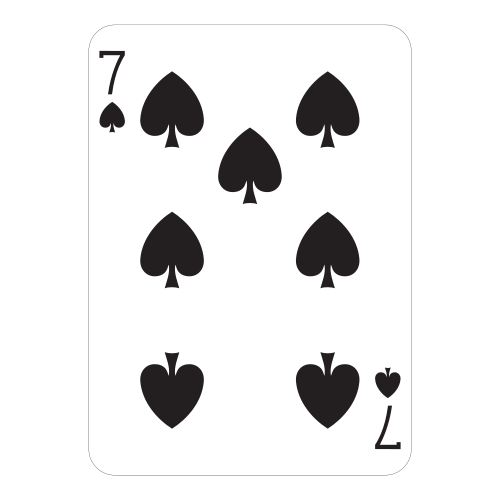
Four players: you and Bo are partners against Ada and Cleo. Ada deals, and you are on her right, so you get the first five cards: A♠, K♠, 10♠, 7♠ and Q♦.
Four spades. You call spades. Then everyone gets four cards, and four more.
Running the tricks
You lead A♠ and K♠, and the opponents' spades start to fall. Bo wins with the ace of hearts, you take a diamond, and trick after trick goes to your side.
The tricks lie in a bundle in the middle: one, then two, then five, all yours.
Seven to none
After seven tricks your side has all seven and Ada and Cleo none. The hand is won — but with the kot rule on, it does not stop. You play on for all thirteen, worth three points instead of one.
Ada and Cleo now have one goal: win a single trick.
The kot breaks
On the ninth trick Ada plays the ace of clubs, which she had kept for exactly this, and nobody after her can beat it. The kot is gone, and the hand ends there: eight tricks to one.
Your side scores one point, and because you won, you keep the call for the next hand.
A kot made
Two hands later you call hearts on five strong cards, and this time your side takes all thirteen. That is a kot: three points.
With the game to five, that kot and the earlier hands put your side over the line.
What the game shows
Ada's ace of clubs was worth two points to her side: kept back for the moment the kot was on, it turned three points into one.
And the call matters: a side that keeps winning keeps choosing trumps, which is why a single-trick win at seven is never a small thing.
Found a mistake, or something unclear, in these rules? Tell us